




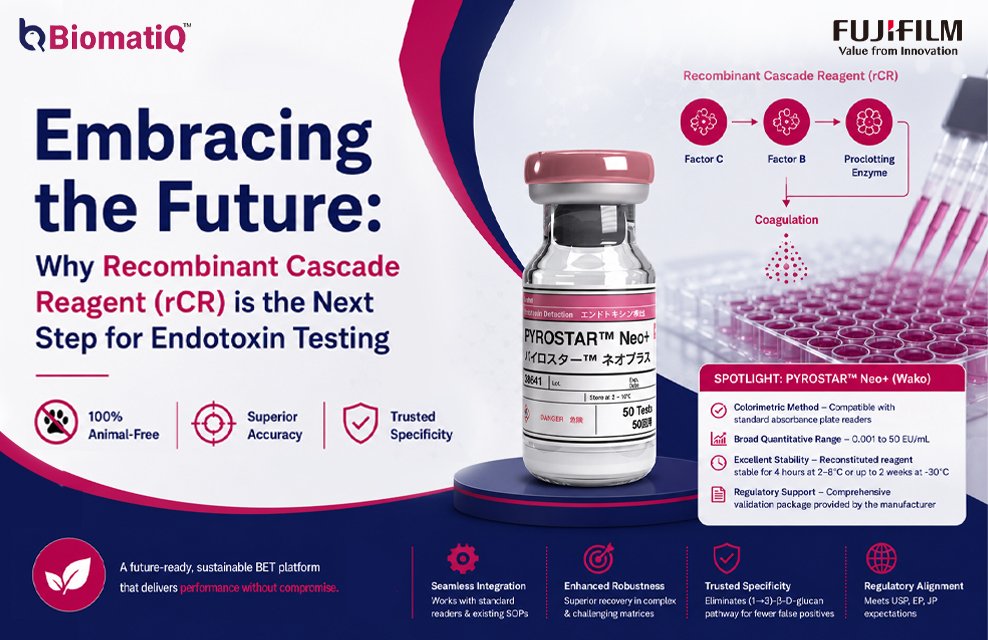
Embracing the Future: Why Recombinant Cascade Reagent (rCR) is the Next Step for Endotoxin Testing
Bacterial Endotoxin Testing (BET) is critical for quality control , but for years, the industry has relied on Limulus Amebocyte Lysate (LAL) derived from horseshoe crab blood. As the industry shifts towards sustainability and regulatory expectations evolve, adopting animal-free recombinant technologies is accelerating. While first-generation alternatives like Recombinant Factor C (rFC) exist, Recombinant Cascade Reagent (rCR) has emerged as the next-generation solution, offering significant advantages by closely replicating the natural LAL enzymatic cascade.
The rCR Advantage: Moving Beyond First-Generation Recombinants
rCR doesn’t just replace animal-derived components; it improves upon them by incorporating all three essential recombinant clotting factors: Factor C, Factor B, and Proclotting Enzyme. This “complete cascade” approach results in key benefits:
1. Seamless Integration with Existing Infrastructure A significant barrier to adopting new technology is capital investment. Unlike rFC, which often requires specialized fluorescence detection systems , rCR is designed for compatibility with standard equipment.
- Use Existing Readers: rCR operates on conventional absorbance-based plate readers and kinetic tube readers, detecting at 405 nm and 650 nm.
- Minimal Training: Because rCR employs methodologies identical to conventional LAL testing, laboratories can integrate it with minimal changes to SOPs and software.
2. Enhanced Robustness and Accuracy By faithfully reproducing the native coagulation cascade—rather than relying on a single enzyme like rFC—rCR provides superior reliability.
- Superior Recovery: rCR demonstrates improved endotoxin recovery, particularly when dealing with complex or challenging sample matrices.
- High Sensitivity: rCR matches or exceeds the sensitivity of traditional LAL assays, often providing lower detection limits than single-enzyme systems.
3. Specificity You Can Trust False positives can lead to costly delays. Like rFC, rCR eliminates the (1→3)-β-D-glucan pathway, which is the primary cause of false positives in traditional LAL assays. Furthermore, rCR is engineered to maximize stability and result consistency.
Spotlight: PYROSTAR™ Neo+ (Wako)
As a leader in recombinant technology, the PYROSTAR™ Neo+ line exemplifies the power of rCR. It is a 100% animal-free reagent that mimics the traditional LAL cascade reaction to provide high sensitivity and specificity.
Key Features of PYROSTAR™ Neo+:
- Colorimetric Method: Compatible with standard absorbance plate readers.
- Broad Quantitative Range: Effective from 0.001 to 50 EU/mL.
- Excellent Stability: Reconstituted reagent remains stable for 4 hours at 2-8°C or up to 2 weeks at -30°C.
- Regulatory Support: Comes with a comprehensive validation package provided by the manufacturer.
Conclusion: A Future-Ready BET Platform
While rFC was a vital step toward sustainability, rCR is the optimal “drop-in” replacement for laboratories that require high analytical performance without the need for major equipment changes or SOP revisions. By choosing rCR, laboratories align with global pharmacopoeial expectations (USP, EP, JP) while ensuring a stable, animal-free supply chain for the future.